![[syndicated profile]](https://www.dreamwidth.org/img/silk/identity/feed.png) snopes_feed
snopes_feedU.S. Central Command said Kuwaiti air defenses shot down three U.S. fighter pilots in an "apparent friendly fire incident."
snopes_feedsnopes_feedsnopes_feedscalziwhatever_feedI woke up this morning and there was a whole new blanket of snow on the ground. Which I don’t love! Here in March! But I guess it is still technically winter for another three weeks, and also, it made this particular cover song I was working on more appropriate. The original is from Fountains of Wayne, which is best known for “Stacy’s Mom,” although songs like this one are rather more in line with the songwriting typical of the group. This is one of my favorites, and a little bit of a deep cut. But deep cuts can be good sometimes. Enjoy.
— JS
snopes_feedsnopes_feedwriterbeware_feed
For writers chasing a traditional publishing contract, an email from Big 5 publisher Simon & Schuster inviting submission might seem like a dream come true.
Just one problem: major publishers like S&S, which acquire mainly via reputable literary agents and expect manuscripts to come to them rather than the other way around, don’t email random authors out of the blue. Also, impersonation scams are extremely common these days, with fraudsters posing as publishers, literary agents, film production companies, even editors (see my previous post on this subject). Any publishing- or movie rights-related email or phone call that you can’t tie directly to a submission or a contact you yourself made is highly likely to be a scam–and with generative AI infesting every aspect of the writing scam industry, the scams can be quite elaborate and authentic-seeming.
Given the amount of time I spend writing and warning about such things, it’s always funny (well, kind of) when an impersonation scammer tries to target me.
A few weeks ago, this landed in my Inbox.
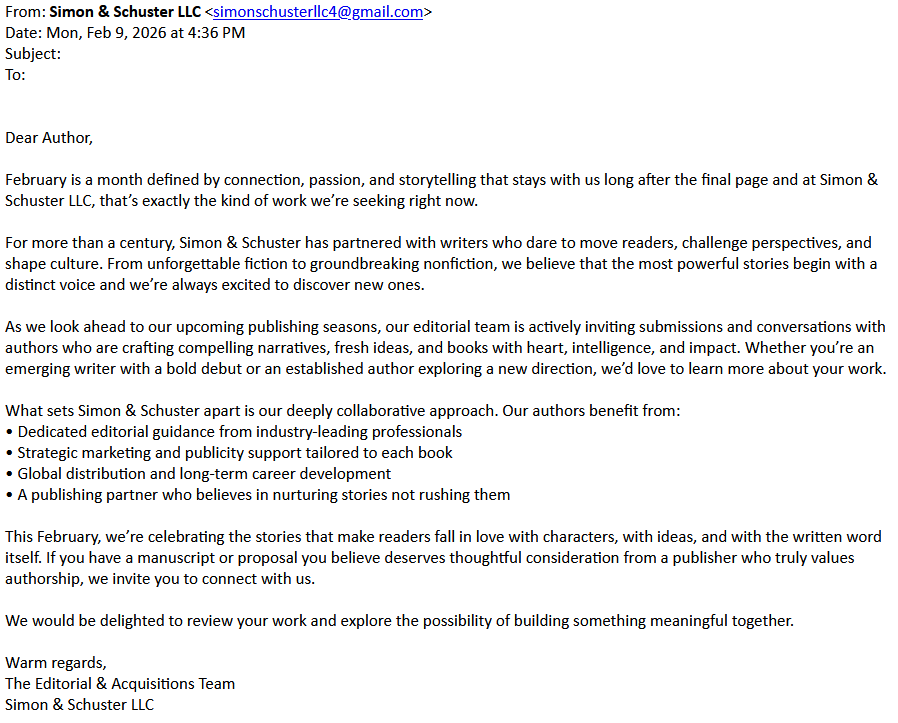
Beyond the two warning signs mentioned above, the email address is a huge red flag. A Big 5 publisher (or, in fact, any other publisher) would be emailing from their own web domain–not a Gmail address. (Gmail addresses are also a feature of a certain type of scam from overseas.) Nor does a publisher like S&S need to tout the benefits it provides as if it were competing for authors (which it very much doesn’t have to do).
I decided to have some fun.
“Tell me more!” I wrote back, in the guise of a first-time author. Within hours, I received an invitation to submit, along with a fairly standard list of information to include. (Another marker of fakeness: the response arrived at 2:22 am my time on February 11, but the timestamp in the header indicated that the scammer sent it at 8:22 am, also on February 11. Since both I and S&S are on the East Coast of the USA, there shouldn’t have been any time difference at all. That discrepancy, with the scammer six hours ahead, was evident throughout our email exchange.)
Here’s what I sent, attaching three chapters of an unmarketable trunk novel donated by a friend of Writer Beware for use in just such circumstances. As you can see, I didn’t try to make it convincing–nor did I delete my signature, which includes not just my personal website, but both of the sites I run for Writer Beware.
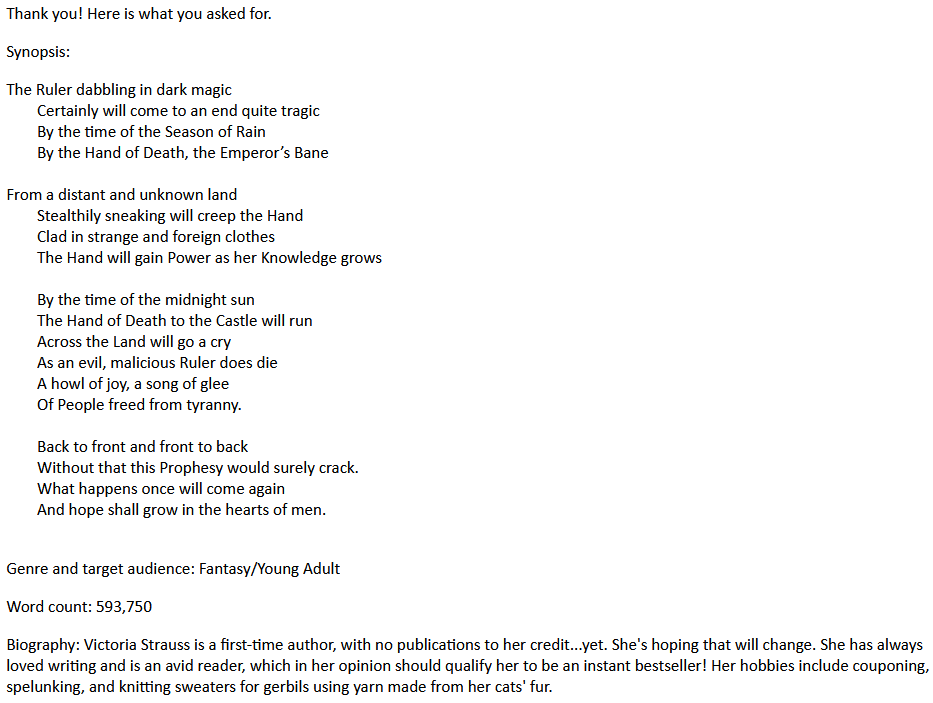
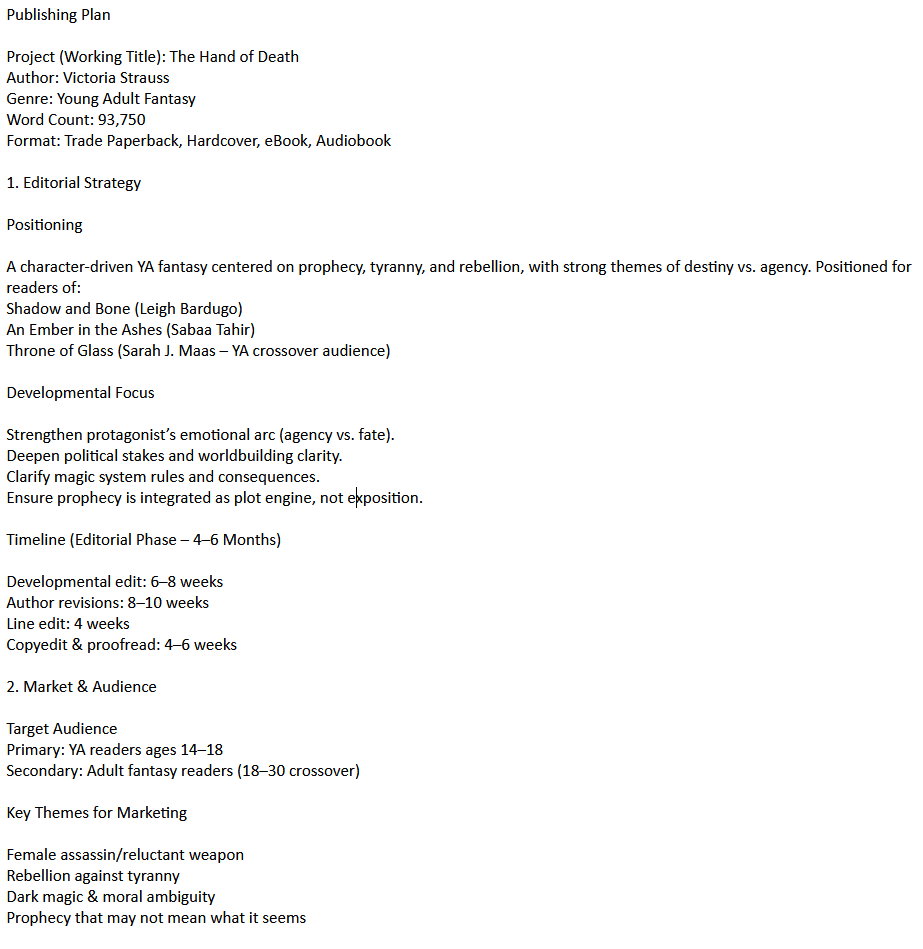
This is the kind of query that publishers (or agents) tend to immediately delete. But S&S loved it! Within hours I received–oh joy!–a publishing offer, plus an extremely elaborate “publishing plan” covering all the many things S&S intended to do for me and my terrible book: editing, production timelines, marketing and sales strategy, author platform development, series and movie potential, and much more. And the cherry on top of this very fake sundae: a $500,000 advance, guaranteed to make any newbie author’s head explode.
The snippet below represents less than a quarter of the email, but it should give you a sense of the level of detail. This kind of ornate confabulation costs the scammer nothing, since it’s all done with prompts and chatbots.
Naturally, newbie writer Victoria Strauss was thrilled. “This is so amazing! Sign me up!” I wrote back. At which point the “switch” part of the bait-and-switch kicked in (note the ongoing time difference, with the scammer six hours ahead: this arrived at 6:54 pm my time, on February 11).
![Subject: Re:Date: Thu, 12 Feb 2026 00:54:55 +o100 From: Simon & Schuster LLC <simonschusterllc4@gmail.com>To: Victoria Strauss [redacted]Which payment method works best for you? Would you prefer a wire transfer or PayPal? Also, please let me kknow the amount you're comfortable paying.](https://writerbeware.blog/wp-content/uploads/2026/02/Simon-Schuster-impersonation-payment-1.png)
Wait, what? Novice novelist Victoria Strauss was confused. Why would she have to pay? Wasn’t it true that traditional publishers never required authors to pay for anything? What was going on?
There followed a lengthy back-and-forth, with me asking innocent questions and the scammer trying to convince me that asking me to “invest” $200 to $500 in my literary future was actually a totally normal thing that S&S would do. Throughout these interchanges, they nudged me whenever I took a few hours to respond: how are you doing today? What do you think? Can we move forward with this now? This kind of pressure, along with claims of limited time or limited openings, is a common scammer tactic: they want to hurry you up so you don’t have time for careful thought.
Eventually they abandoned the traditional publishing pretense and admitted that what they were really trying to sell me was self-publishing–apparently expecting me to forget the elaborate trad pub plans and gigantic advance they’d initially promised. (Notice that the scammer is no longer signing off as “The Editorial & Acquisitions Team”, but with a probably fictitious name.)
![Subject: Re:Date: Fri,, 13 Feb 2026 18:01:30 +0100From: Simon & Schuster LLC <simonschusterllc4@gmail.com>To: Victoria Strauss [redacted]Dear Victoria,I’m really glad you asked your question it shows that you’re thinking like a professional author.You’re absolutely right that a traditional publisher such as Simon & Schuster does not charge authors upfront. In that model, they invest in a very small percentage of submissions and assume all financial risk.However, that path is highly competitive and selective. Fewer than 1% of submitted manuscripts are acquired by major traditional houses. The alternative independent publishing done strategically and professionally allows you to move forward without waiting for gatekeepers, while still producing a book that meets industry standards.The investment I mentioned is not a “fee to get published.” It is a targeted investment in professional tools that directly impact:• Market positioning• Editorial polish• Metadata optimization (which affects discoverability)• Professional presentation and credibility• Distribution readinessIn independent publishing, you are essentially stepping into the role of the publisher. And like any publisher, there are production and positioning costs if the book is to compete seriously in the marketplace.The key difference is this:With a traditional publisher, they invest in you but you give up control, timeline, and a significant share of royalties.With an independent model, you invest in your own project and retain control, ownership, and higher long-term earnings potential.My goal is not to sell you anything unnecessary. It’s to ensure that if you choose to publish independently, you do so in a way that protects your credibility and maximizes your book’s success. Cutting corners in the early stages often costs more later in missed sales, poor reviews, or limited visibility.If your goal is strictly traditional representation, I will respect that and can even outline the proper route for querying agents. But if your goal is to see your book professionally published and positioned within a predictable timeline, then investing in the right tools is often the most strategic and empowering choice.Ultimately, this is about choosing the path that aligns with your goals, risk tolerance, and timeline. I’m here to support whichever direction you decide transparently and professionally.Warm regards,Zahara Page](https://writerbeware.blog/wp-content/uploads/2026/02/Simon-Schuster-impersonation-rationale-1.png)
The prices, which it took them another couple of emails to cough up, ranged from a fairly standard self-publishing starter package for $1,500 to an “elite bestseller package” padded with ripoff nonsense like “full author branding strategy” and “ongoing post-launch performance tracking” for $15,000. Yet another switch, since a few emails back they’d told me I’d be paying $500 at most.
I could have gone back and forth with Zahara/fake S&S much longer than I did (one of the hallmarks of AI-driven writing scams is the scammers’ willingness to engage in near-endless email dialog in order to keep the potential victim on the hook), but I have, you know, a life, and anyway it was no longer interesting.
So I asked, as I always do when I lead scammers on, for payment information, specifically requesting wire transfer instructions, since that forces them to hand over banking information. (Note: you should NEVER do this. Unlike credit card payments, wire transfers can’t be reversed…which is why scammers like them.)
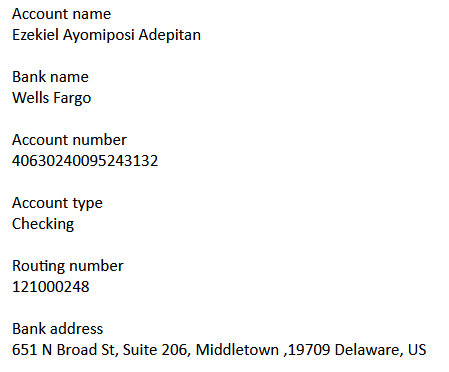
Requiring payment to a third-party, often described as a “financial manager”, is typical of AI-driven scams from Nigeria, which, per the many wire transfer instructions I’ve collected from scammers over the past months, favor accounts with Wells Fargo and to a lesser extent, Kansas City-based Lead Bank.
Additionally, the name on the account is Nigerian; and remember the six-hour time difference? Nigeria is six hours ahead of the US East Coast, where I am. An additional indicator: the +0100 that follows the timestamp in the emails above. It identifies timezones that include West Africa, and is a useful, though not infallible, way to tell where a scammer is really located (since most scammers from overseas have fake US, UK, or Canadian business addresses).
Remember I mentioned the nudging? Fake S&S “followed up” three times in the two days after they sent the payment information (AI scammers often keep pushing for a tedious amount of time, even if you refuse their offers or tell them in no uncertain terms to buzz off). Their final message:
![Subject: Re:Date: Fri,, 19 Feb 2026 12:03:47 +0100From: Simon & Schuster LLC <simonschusterllc4@gmail.com>To: Victoria Strauss [redacted]Oloribu ni oo ni Victoria](https://writerbeware.blog/wp-content/uploads/2026/02/Simon-Schuster-impersonation-insult.png)
Which Google Translate says means “It’s a disaster”, but the wider internet suggests is a harsh Yoruba insult. So maybe they figured it out?
At any rate, it was time to terminate this small adventure. So I blocked them.
I had fun trolling the S&S impersonator by pretending to be a clueless newbie author. But such scams are no joke. They are aggressive, prevalent, and the use of generative AI can make them extremely polished and convincing–not just impersonation scams like this one, but the highly personalized approaches that are flooding writers’ Inboxes, with lavish details and glowing praise designed to make you believe that the scammer has really read your book.
The goal, always, is to trick writers into handing over money. Though the scammer may not say so initially, that’s the destination they will inevitably arrive at. Any demand for money where upfront payment isn’t standard–which includes not just traditional publishers and literary agents, but Goodreads Litopia lists, self-publishing on KDP and IngramSpark, book club invitations, reading challenges, magazine features, print and radio interviews, and more–is a warning sign.
Hopefully this post has suggested some useful tricks and tools you can use to recognize and investigate the scams that land in your Inbox.
The post Not Simon & Schuster: Deconstructing an Impersonation Scam appeared first on Writer Beware.
writerbeware_feed
This is yet another Writer Beware post about allegations of royalties long left unpaid. But it’s also about the challenges of work-for-hire arrangements, and what can potentially go wrong when intellectual property repeatedly changes hands.
The BattleTech and Shadowrun franchises–which included both games and novels–were originally developed and published in the 1980s and 1990s by FASA Corporation, a publisher of role-playing and board games. FASA closed down in 2001, and the two franchises were transferred to a new company called WizKids, founded by former FASA employees.
In 2003, the Topps Company, which manufactures trading cards and other collectibles (and candy, including the iconic Bazooka bubble gum), acquired WizKids and its IP, in a bid to expand its entertainment holdings. Topps closed WizKids down in 2008, citing economic factors; it subsequently sold WizKids and its IP to the National Entertainment Collectibles Association, but retained rights to BattleTech and Shadowrun.
Topps itself has changed hands more than once; it’s now owned by digital sports platform Fanatics Inc., which acquired it in 2022.
In 2016, Topps signed new contracts with two authors and two authors’ heirs for a total of fourteen books in the BattleTech and Shadowrun universes, written between 1996 and 2003 and published originally by FASA or WizKids (you can see all four contracts here, here, here, and here).
As with most novels produced for media franchises, the original publishing contracts were work-for-hire, with the publisher owning the copyrights. The new Topps contracts supersede those original agreements, with no gap between old and new (the old contracts are said to have “remained in full force and effect up until the Effective Date” of the new agreements, and also to have terminated as of that date) and no rights under the old agreements reverting to the authors. The copyright assignment “is deemed to apply retroactively to the date of initial publication of the Works by Publisher’s Predecessors”.
Language in the new contracts alludes to disputes between the authors/heirs and the original publishers, involving royalties and other matters:
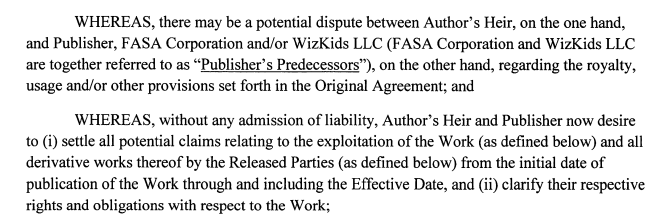
There are also payments to the author or heir of one-time fees (Clause 7.a.) as “full and complete settlement of any Claims” up until the effective date of the new contracts; and a clause releasing Topps and its predecessors from all claims and liabilities, and barring the authors/heirs from suing Topps or its predecessors for any claims under the old contracts, including for “any failure to report or pay royalties under the Original Agreements and/or the unauthorized licensing of rights beyond the scope of the Original Agreements.”
All of which makes it at least somewhat ironic that the same authors and heirs are now suing Topps for non-payment of royalties under the new agreements.
The lawsuit, which can be seen here, alleges breach of contract, claiming that Topps has failed to report or pay royalties for any of the contracted books for 2022, 2023, and 2024, despite “repeated demands” (note the additional allegation in #19 below, which points to delinquency on the part of the original publishers):
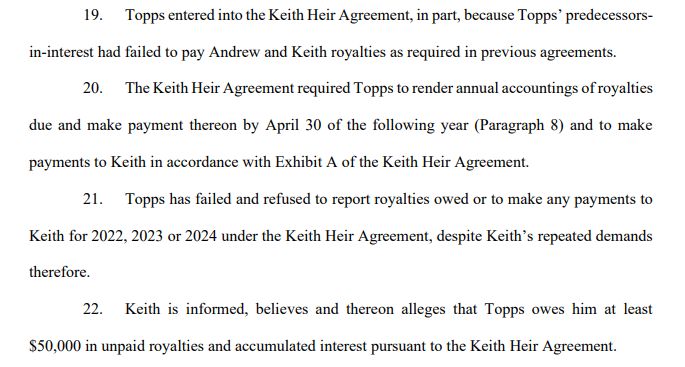
Each of the authors/heirs make similar allegations. Overall, they estimate that they are owed at least $200,000 in unpaid royalties, and are asking the court to award monetary damages of at least that amount plus interest, compensatory damages of at least that amount plus interest, and the authors’/heirs’ attorney fees and expenses.
The lawsuit was filed last August in the Supreme Court of New York County, and service was acknowledged in October.
Since then, there doesn’t appear to have been any movement in the case, with no response as yet from Topps. (Case documents are public record and can be accessed online; click the Case Information link in the right-hand menu and then paste in the case index number, which can be found in the top right corner of each page of the lawsuit.)
Work-for-hire is an area of publishing where exploitative contracts and poor treatment of writers is all too common. In this case, the repeated transfers of IP and the apparent failures of the original publishers make the situation even more complicated.
I will keep an eye on the case and update this post as information comes in. If you’re a BattleTech or Shadowrun author with complaints similar to those in the lawsuit, please reach out to SFWA or contact Writer Beware.
The post Authors and Authors’ Estates Sue The Topps Company for Unpaid Royalties appeared first on Writer Beware.
snopes_feeddinosaur_comics_feed| archive - contact - sexy exciting merchandise - search - about |

| ← previous | March 2nd, 2026 | next |
March 2nd, 2026: Okay Toronto dried out some; thank you Toronto. – Ryan | ||
snopes_feedsnopes_feedgirlgenius_main_feedsnopes_feedsnopes_feedsnopes_feedsnopes_feedsnopes_feedsnopes_feed - Fake image of man in Kuwait confronting crashed US fighter pilot spreads after jets shot downsnopes_feed - Vance once wrote op-ed claiming Trump's best foreign policy during first term was 'not starting anysnopes_feed - Department of Education hung Charlie Kirk banner on DC building near education heroes messagescalziwhatever_feed - New Cover: “Valley Winter Song”snopes_feed - Did school officials try to 'secretly transition' Sage Blair, Trump's 2026 State of the Union guest?snopes_feed - Story of Punch the monkey finding comfort in stuffed animal after abandonment melts heartssnopes_feed - Why Stevie Wonder appears in Epstein files for refusing to perform for Israeli armywriterbeware_feed - Not Simon & Schuster: Deconstructing an Impersonation Scamwriterbeware_feed - Authors and Authors’ Estates Sue The Topps Company for Unpaid Royaltiessnopes_feed - 23 rumors about Erika Kirk we've examineddinosaur_comics_feed - we're all in this together, and by "this" i mean "being forced to devour other life if we wish to masnopes_feed - Contextualizing claim deployed US Navy sailors pay for their meals at seasnopes_feed - Did ex-Prince Andrew say royals couldn't play Monopoly because 'it gets too vicious'?girlgenius_main_feed - Girl Genius for Monday, March 02, 2026snopes_feed - 7 claims about Leonardo DiCaprio we've screenedsnopes_feed - Breaking down false claim 'jerky' in Epstein files references human meatsnopes_feed - Mexican cartels: 6 rumors we've unpackedsnopes_feed - Did Mitch McConnell and Kevin McCarthy discuss 'bringing back slavery' on phone call? There's no prooglaf_comic_feed - Pamphletssnopes_feed - Did Jesse Jackson's family say they didn't want Obama at funeral? Don't believe claim![[personal profile]](https://www.dreamwidth.org/img/silk/identity/user.png) momijizukamori
momijizukamori